How to defeat aging
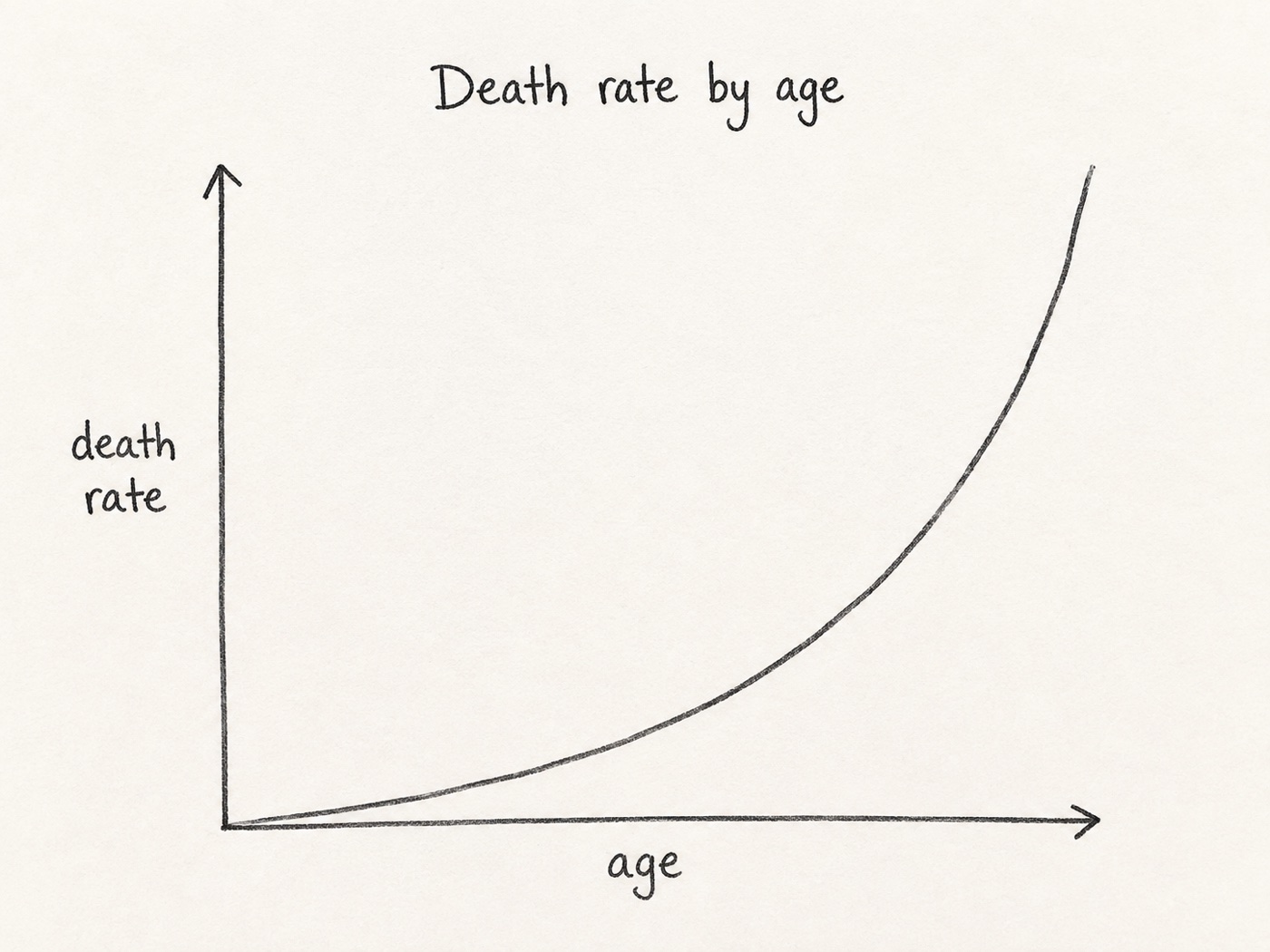
As you get older, the chance that you will die goes up.
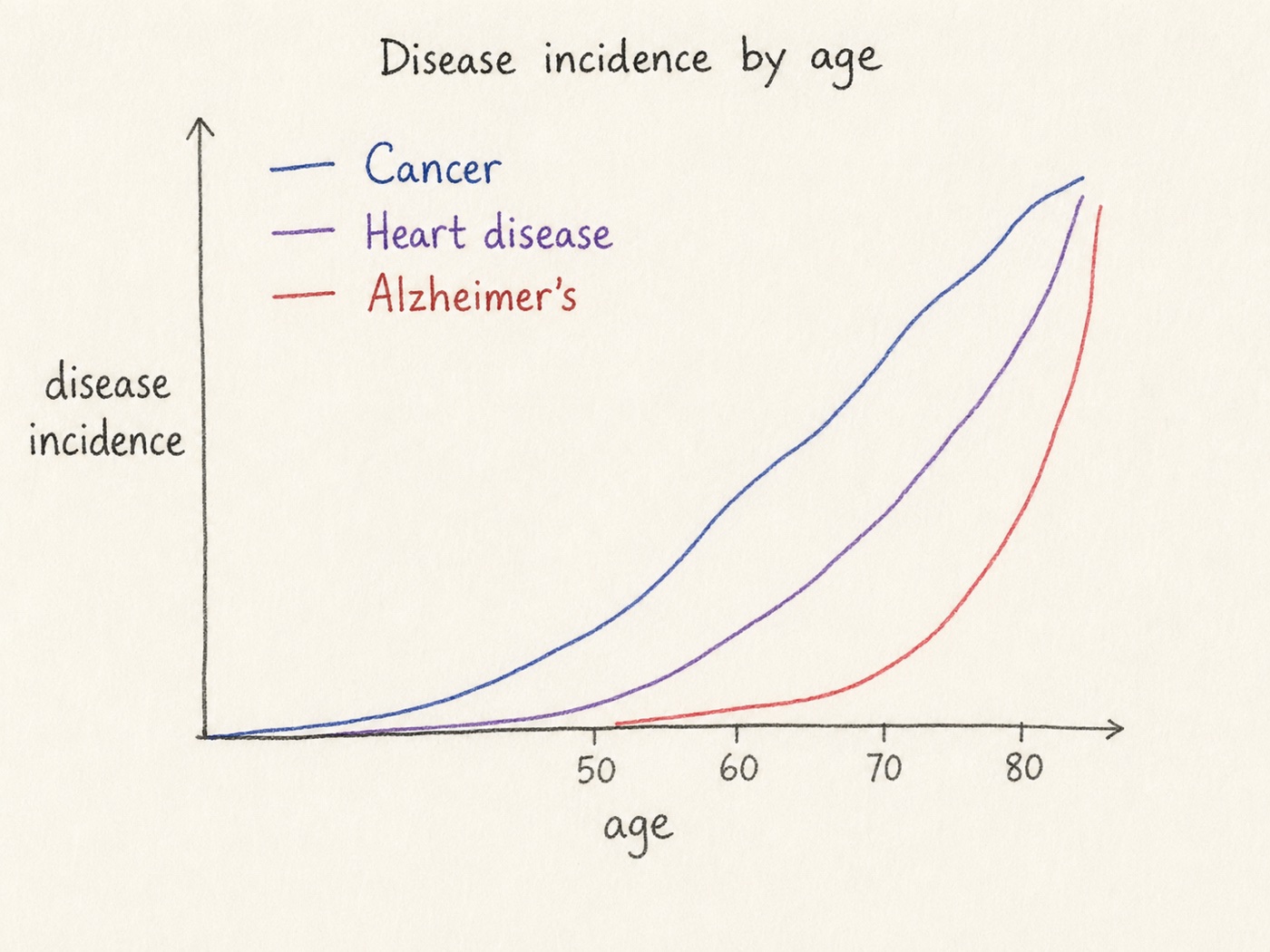
As you get older, the chance that you will die from certain diseases also goes up.
Why does this happen?
One widely accepted view is by Aristotle. He believed organisms grow old and die “for the good of the species”. While this answers the question at a metaphysical level, it fails to explain the deeper root cause.
We know moon jellyfish can reset their cells back to a younger version. Infinitely. They never age. So aging isn’t a law of nature.
If Aristotle’s view is incomplete, what else explains?
Enter DNA. Think of DNA as a giant instruction manual every cell carries a full copy of. It’s written in a 4-letter alphabet — A,T,C, and G. Similar to how computer binary digits are stored 0 or 1. The DNA manual is 3 billion characters long. Buried in that manual are 20,000 separate instructions, or recipes, called genes. These genes cover everything a cell needs to become: skin, hair, heart, or brain. For a skin cell, the skin recipe contains how to form, survive, and die. But the recipe alone doesn’t contain when to use those instructions. Something else decides, we’ll get to it later.
When DNA was first discovered in 20th century, the dominant view shifted to accumulated DNA damage as cause of aging. Accumulated damage, like an old car losing efficiency, is said to cause mutations. Giving rise to tumors, cancers, and other diseases.
But why does DNA damage occur in the first place? The answer may surprise you: randomness.
Really?
Yes. Randomness of accumulated internal and external DNA damage. Internally, roughly 300 billion cells divide each day, causing 2 trillion DNA breaks. This copying is necessary part of day-to-day functioning. However, each time a cell divides, it copies the entire manual. Like photocopying an original document 100’s of times, each subsequent copy introduces a slight errors.
External damage happens through food, cigarettes and UV exposure. When and where the damage lands is pure chance. That’s why two identical twins, with the exact same DNA, can die at different ages.
So aging is just bad luck? We thought so, till a group of scientists ran the ultimate photocopy test. They “cloned” an animal cell. They took DNA of an adult cat and used it to make a young cat. They named her CC, short for Carbon Copy.
Hold on a second. If cloning older animal’s DNA into new born animal, shouldn’t the new born die early? Since the DNA manual is meant to contain accumulation of photocopying errors?
It turns out, no. CC lived as long and as healthily as any normal cat, reaching 18 years old. When I read this, I immediately thought of Dolly the sheep, the first mammal to be cloned. Dolly did die young, but from a common sheep virus, not damaged DNA. Since then, cloned animals have lived normal lifespans.
Simply put, cloning shows no DNA damage occurred. The older car didn’t lose any information inside it. The DNA theory of aging was wrong.
If it’s not DNA, what is the cause of aging?
It’s loss of information in the epigenome.
Epigenome
If DNA is a set of instructions, like a musical book containing notes of all songs ever written, the epigenome is the musician deciding which song to play.
The book alone isn’t enough. A skin cell and a brain cell carry the same exact book, all 20,000 songs. So what makes one skin and one brain? Which songs get played. That’s epigenome’s job. Without it, a cell would quickly lose its identity. Imagine a skin cell playing the brain cell’s songs.
But how does the musician keep track during performance? He can’t play and turn book pages at the same time. Luckily, he has page-turners.
Page-turners sit beside musicians, flipping pages as the notes are played. Ours are special: they don’t just flip, they also manage which pages are read and skipped, making sure the musician always plays the right song.
If today’s performance is classical, they keep classical pages open. Rock, jazz and punk pages are skipped.
It’s these open and skipped pages that decide a cell’s identity. Not the music itself.
Identical twins prove this. Same book, page for page. But if one twin smokes and one doesn’t, the smoker ages visibly faster. The songs didn’t change. Which pages were being played did. Studies of identical twins put the genetic influence on longevity at just 10%. The rest 90% of aging destiny is decided by day-to-day actions. Our DNA is not our destiny.
And here’s the cause of aging: the page-turners keep getting interrupted. Why? Because they have a second job. When something breaks backstage mid-performance, they're also the repair crew. Each time there's a technical failure, they leave their posts, rush off, and fix it. Then they return.
But as every creative person knows, interruptions break the flow. Rushing back to resume the performance, a page-turner only vaguely remembers where they left off. Usually they find the right page. Sometimes they reopen a wrong one, or leave a right one closed. At first, this barely affects the musicians’ performance. A few minutes later, it happens again. With increasing frequency, again and again.
Eventually, enough wrong pages are open that the musician starts playing rock music instead of classical.
The performance is ruined.
Why does this happen? We don’t know the full reason. What we know is the loop: damage, interruption, repair, return, wrong pages left open or skipped. This loop is the cause of aging.
But notice something strange about this setup. The same page-turners who help turn-pages are also the repairmen. Every break backstage pulls them off stage. Why would evolution build a concert like that? It sounds silly.
Two Modes of Existence
It turns out this setup isn’t a flaw. It’s what made us survive for 4 billion years.
Early bacteria developed two different modes of living.
When times were good, they used their energy to grow and reproduce.
When times were tough, they used their energy to protect and repair cells. They activated so-called “longevity” genes. They paused everything, focusing on protecting the epigenome from losing information until conditions improved.
Why did nature make such decision? Logically, it makes sense for nature to pick one strategy and optimise around it. Yet, it didn’t. The reason is limited resources. Growing and reproducing takes energy. Repairing damaged cells takes energy. You can’t fully do both.
If an organism, let’s call him “Adam”, kept reproducing after suffering DNA-damage from external conditions, his offspring would inherit the broken DNA. Eventually killing his entire lineage.
Now Adam had a neighbour, Dan. Dan carried a switch to move between these two modes. When her DNA broke, she turned on “longevity” genes, diverting all energy to repair instead. She focused on survival. When conditions improved, she multiplied.
Dan’s slow, but effective survival strategy eventually won over billions of years of evolution compared to Adam who solely focused on growth and reproduction.
Every living being today carries that switch. And the switch is the same interruption our page-turners suffers when they’re pulled off-stage for repairs. This interruption loop isn’t a bug nature overlooked. It’s the winning strategy. The thing that keeps us alive in the short term is the thing that ages us in the long run.
Which hands us a weapon.
If the repair mode only switches on when the cell believes times are hard, then the way to slow aging is to convince your body times are hard, without actually harming it. There is a word for it: hormesis. What doesn't kill you literally makes you live longer.
If there is one word you take from this essay, remember hormesis.
Is this why yogis live long? Because yogis observe celibacy. No sex is believed to preserve “prana”, or life force, essential to maintain long-life for spiritual cultivation. They also fast, endure extreme heat and cold. Every one of those, we’ll see, activates logenvity genes. The yogis may have found the secret to youth thousands of years before we understood the science.
Our bodies read adversity signs through three main longevity genes: mTOR, AMPK, and Sirtuins. They sound technical. I was scared when I first read them. They’re not. Each one is just a sensor, watching for one kind of scarcity.
The first one watches your dinner plate. And everything the fitness industry told you is wrong.
mTOR
You probably never heard of mTOR?
What about “protein”? You definitely did. Bodybuilders, influencers and celebrities promote high-protein diet as cure for all problems. You can literally find “high protein” labels from chocolate to soda. More protein equals healthy life, they say.
Is it true? For longevity, higher protein equals faster aging. It does this by activating a gene called mTOR. mTOR acts like a growth sensor in our cells. It detects how much amino acids are currently available in our body.
Think of mTOR as construction manager trying to build a house — a “protein house”. He needs 9 different raw materials for stable house. Cement. Iron. Bricks. And others. These 9 raw materials in our bodies are the 9 essential amino acids. Our bodies cannot make them. We need to get it from external sources. Just like our construction manager needs to order from raw material supplier.
When amino acids are abundant, mTOR switches on and says “times are good: let’s grow, build muscles, and burn energy”. Our construction is progressing rapidly.
Sounds perfect, right? Here’s the catch: building and repairing use same limited raw materials. If you recall earlier, longevity genes only activate during scarcity. The faster we construct, the less is spent on maintaining and repairing what’s already there.
So when you eat a big, juicy steak, your body floods with dense amino-acids, especially luecine, isoluecine and valine. These drive up mTOR, and build muscles more efficiently.
Isn’t that a good thing? No. You are borrowing against maintenance to pay for growth.
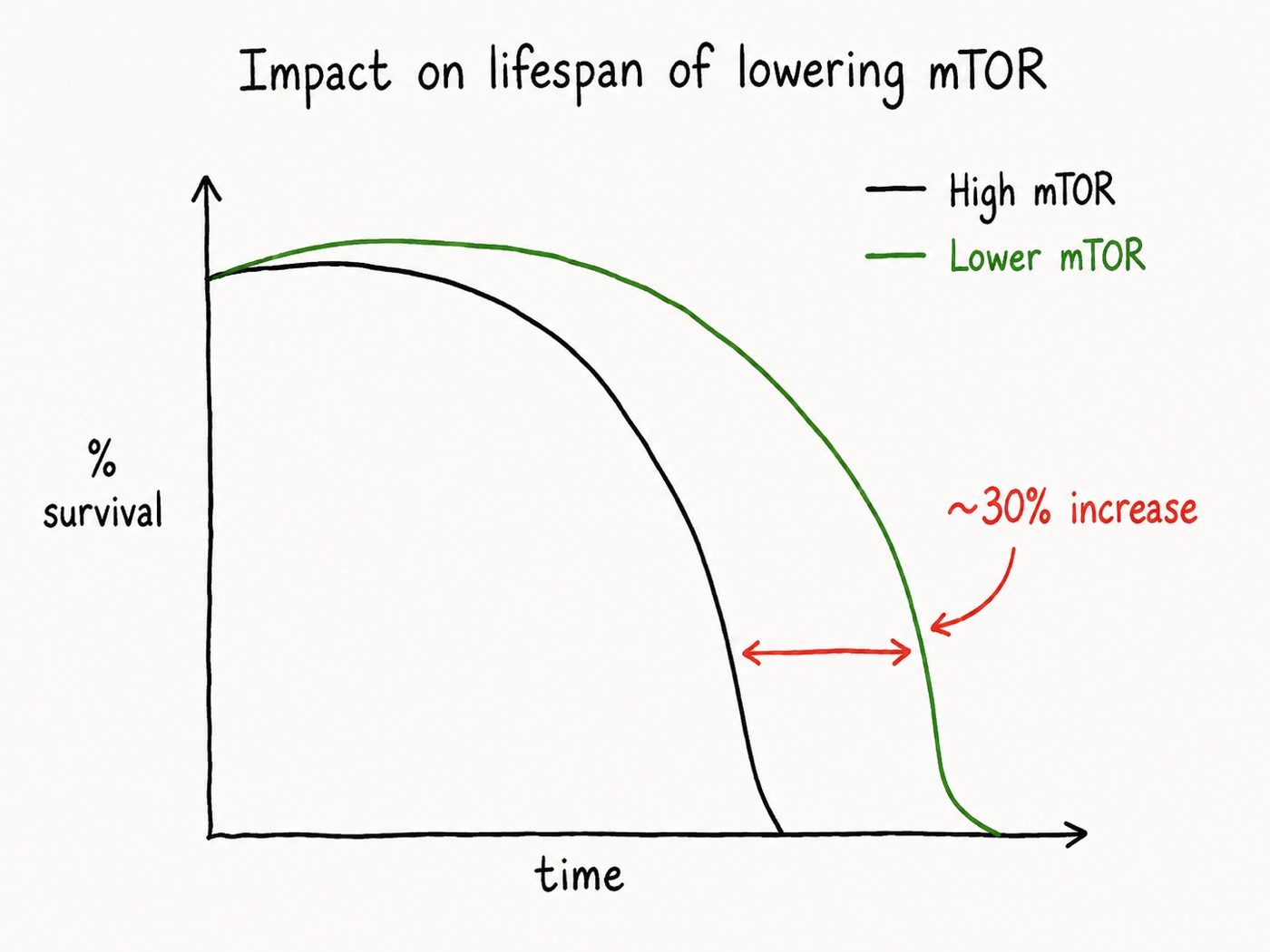
This throws up a dilemma: we need 9 essential amino acids from food. Meat drives up mTOR dramatically. And we need lower mTOR to live longer.
Luckily, nature seems to have found the answer: plant proteins.
Plant proteins deliver all 9 essential amino acids the body needs, just in smaller concentrated doses. While animal protein is like handing your construction manager truckload of every raw material at once. He sees abundance and calls in the whole crew. Plant protein delivers the same 9 materials, just spread thin across a much bigger, slower shipment. The construction manager balances between construction and maintenance.
This explains why vegans suffer significantly lower rates of heart disease and cancer than meat eaters[1].
You might still be sceptical. I basically said slowing aging requires lowering mTOR, and by definition, lower protein.
But every fitness trainer knows higher protein equals faster muscle growth. When I was 18 years old, I consumed 1kg of chicken breast per day. Roughly ~300g protein/day. I was “maximising my gains”, I thought.
Well, a new meta-analysis [2] reviewed all scientific literature on protein and muscle building concluded more protein doesn’t equal to more muscle. In fact, they found more protein, especially 2.2g/kg bodyweight promoted by gym bros, had no benefit. Then what matters most? Progressive overload, gradually increasing workout intensity over time, and total calories [3].
Protein still has a role for muscle growth, but much lower priority. And as I said earlier, we still need 9 essential amino acids from external protein sources to survive.
If so, is there an ideal protein target that balances muscle growth and lowers mTOR? Neither muscle-growth nor aging research answers this question directly. My educated guess is around 1-1.2g/kg bodyweight [4].
This number doesn’t surprise me. My current protein intake went from ~300g to ~90g per day. I see no strength loss or recovery. And I get all my protein from plant-sources.
mTOR tells the body whether it has enough raw material to grow. But growth also depends on whether the body has enough energy to pay for it.
AMPK
Luigi Cornaro was a famous Venetian nobleman considered to be father of self-help genre. He was born in a wealthy family. At age 30, he inherited six houses and 300 acres of land from his uncle — roughly the size of London’s Hyde park.
But Luigi didn’t just retire. He went on a buying spree in Venice, purchasing large areas of marshy, waterlogged, supposedly useless land. He would acquire them for cheap, then use early hydraulic engineering, drainage, ditches and flood barriers, to turn them into productive agricultural land.
This business model made him ultra-rich.
What do you do with all that fortune? What most men only dream of: he spent it on wine and women, describing his lifestyle as “sensual course of life”, organised around maximising physical pleasures.
However, by 40s, he was suffering. He had intense stomach-pain, persistent fever, and digestive issues. He tried many treatments, but nothing worked. In pain, he wished,“from these disorders, the best delivery I had to hope was death.”
So, Luigi decided to try something radical. He began calorie restriction diet, eating just 350 grams a day. And followed the rule of “always leaving the table well able to take more.”
Luigi went on to live past 100 years old. He wrote his secrets in a book, “Discourses on the Temperate Life”, calling longevity desirable and “God wills it”. He showed men could enjoy both earthly existence and heavenly one, simply by living within restraint.
Luigi’s wisdom is as old as history goes. Hippocrates, ancient Greek physician known as father of medicine knew this. So did all sages from Buddha to Yogis.
But what’s the actual reasoning? Why does eating less, not starvation, not malnutrition, lead to longer life?
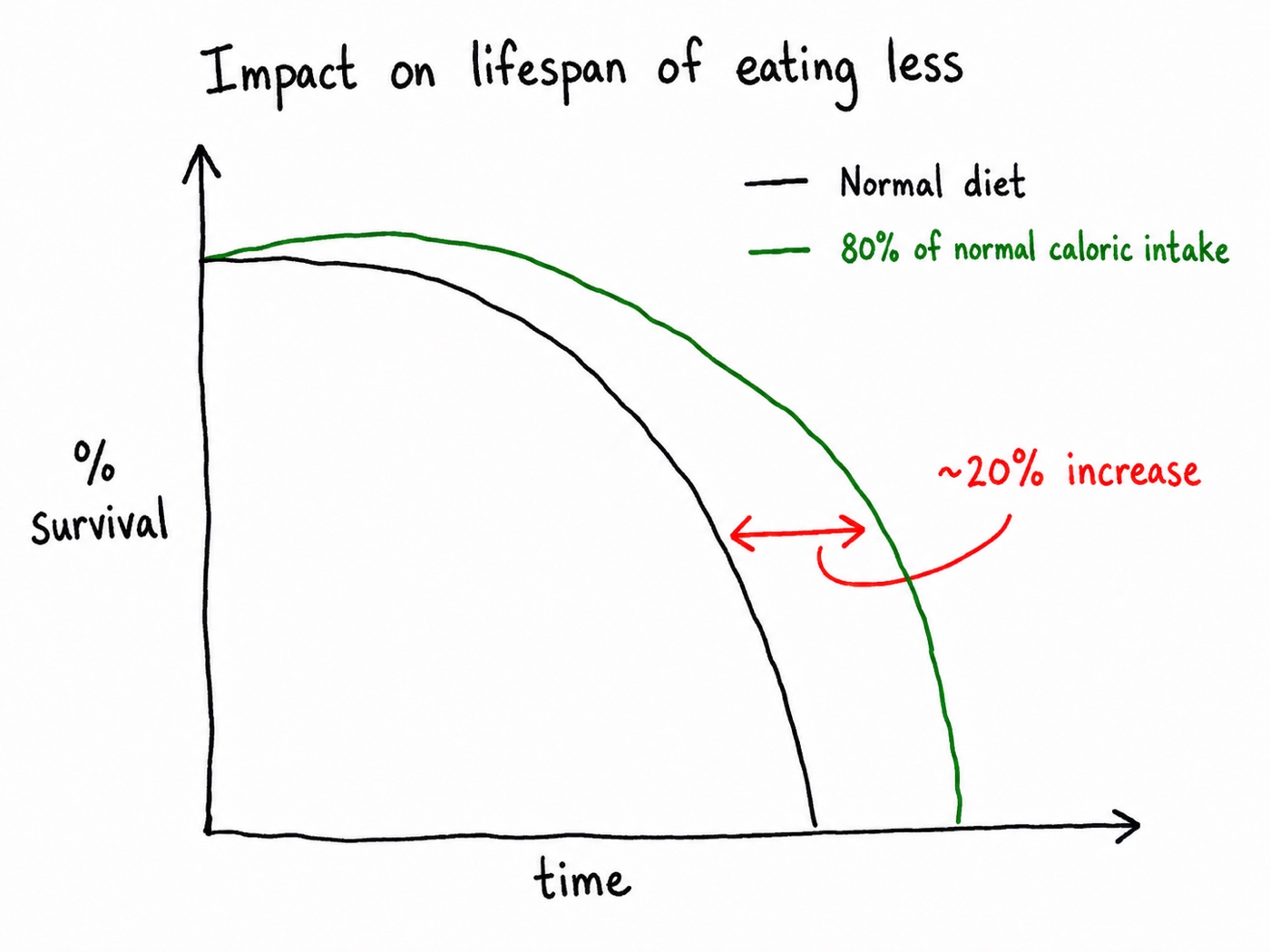
It comes down to longevity gene called “AMPK”.
AMPK acts as energy regulator. Just like mTOR regulates amino acids to build protein, AMPK regulates energy in our cells.
Our cells use a special fuel called “ATP” for energy. AMPK watches how much fuel is left in the tank. When the fuel is running low, AMPK calls on body’s power plant to generate more energy.
These power plants, ancient bacteria called mitochondria, convert sugar and fat from food we eat into ATP.
Restrict calories, and there’s les sugar and fat for mitochondria to covert. Cellular energy drops. The body reads this as “bad conditions” and switches into “protect and repair” mode.
If caloric restriction sounds hard, periodic fasting like intermittent fasting (16:8) or extended fasting [5] has shown similar benefits.
If you are like me, I love food cooked by my partner, especially her Chinese dishes. Instead of daily caloric restriction, I find extended fasts like skipping meals on long-flights easier to do.
Other interventions to activate AMPK include:
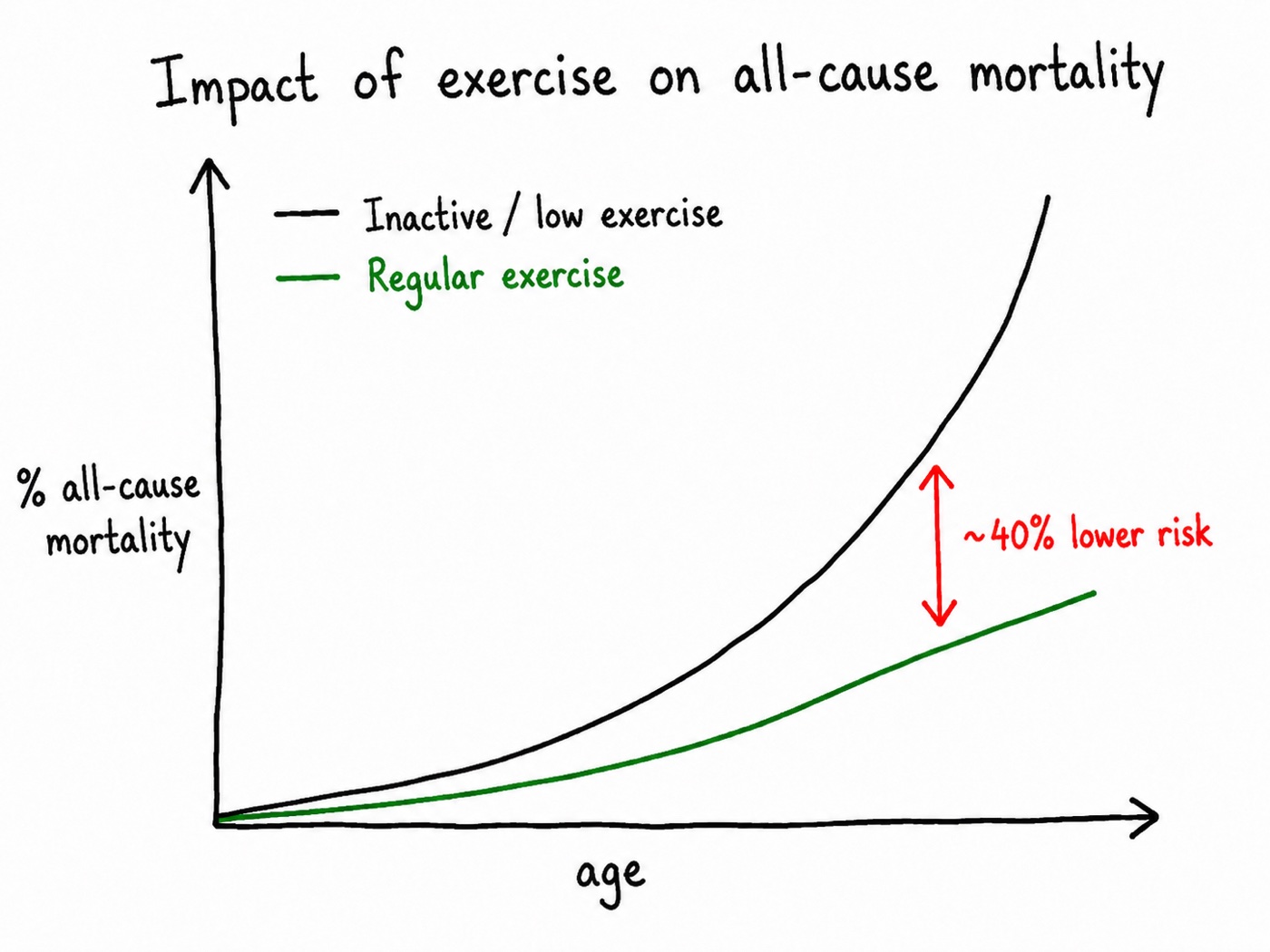
Exercise. Each time you train, your body uses ATP more quickly than it can produce.
Metformin. A drug used by millions of people for type-2 diabetes. We don’t know exactly how it works. But it’s shown to activate AMPK by lowering energy a cell has, tricking your body to produce more ATP.
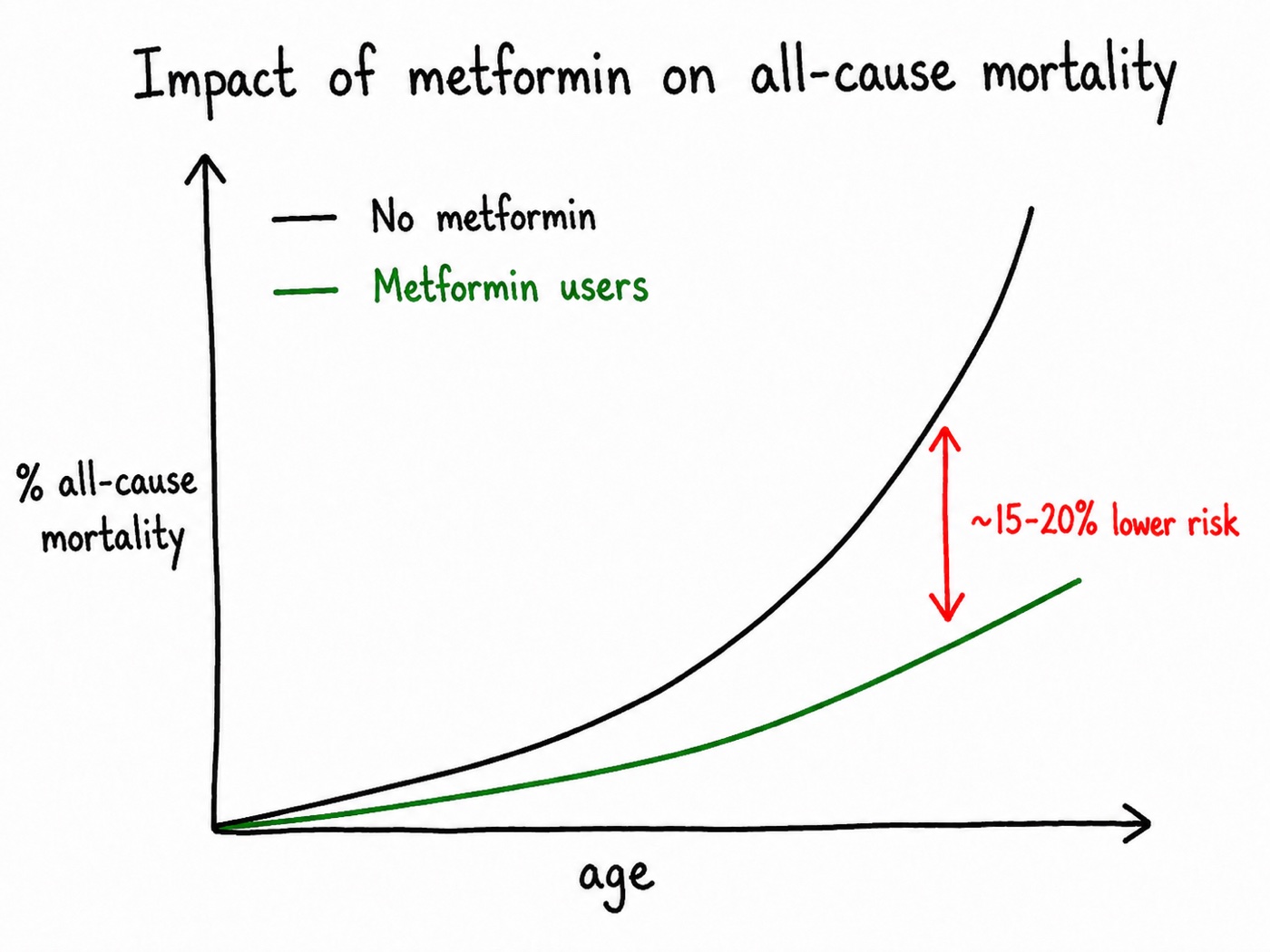
In Western countries, Metformin is only available via prescription. But a natural compound found in plants called “Berberine” is shown to mimic metformin’s properties. Berberine usage goes back centuries in Ayurveda and Traditional Chinese Medicine for improving metabolic health.
Maybe the ancient doctors knew something we didn’t.
Looking at this data, you might wonder, “why don’t we keep AMPK activated at all times”. Intuitively, this makes sense. Since AMPK activation also suppresses mTOR. But if mTOR were permanently off, you would be permanently in repair mode, with no growth at all. Equally damaging as constantly being in growth mode. Neither extreme is good.
What we need is cycling between adverse and abundance modes. This cycling is hormesis. We want intermittent AMPK activation. Think of it like strength training: you stress the system, it adapts, then you recover with higher capacity.
Before heading to third longevity gene, one clarification. So far, I wrote each intervention activating one longevity gene. In reality, they all talk to each other. Working like a longevity network. We don’t know the exact mechanism of how they operate. But keep in mind activating one gene triggers other ones as well. Exercise, for example, activates all three longevity genes.
Sirtuins
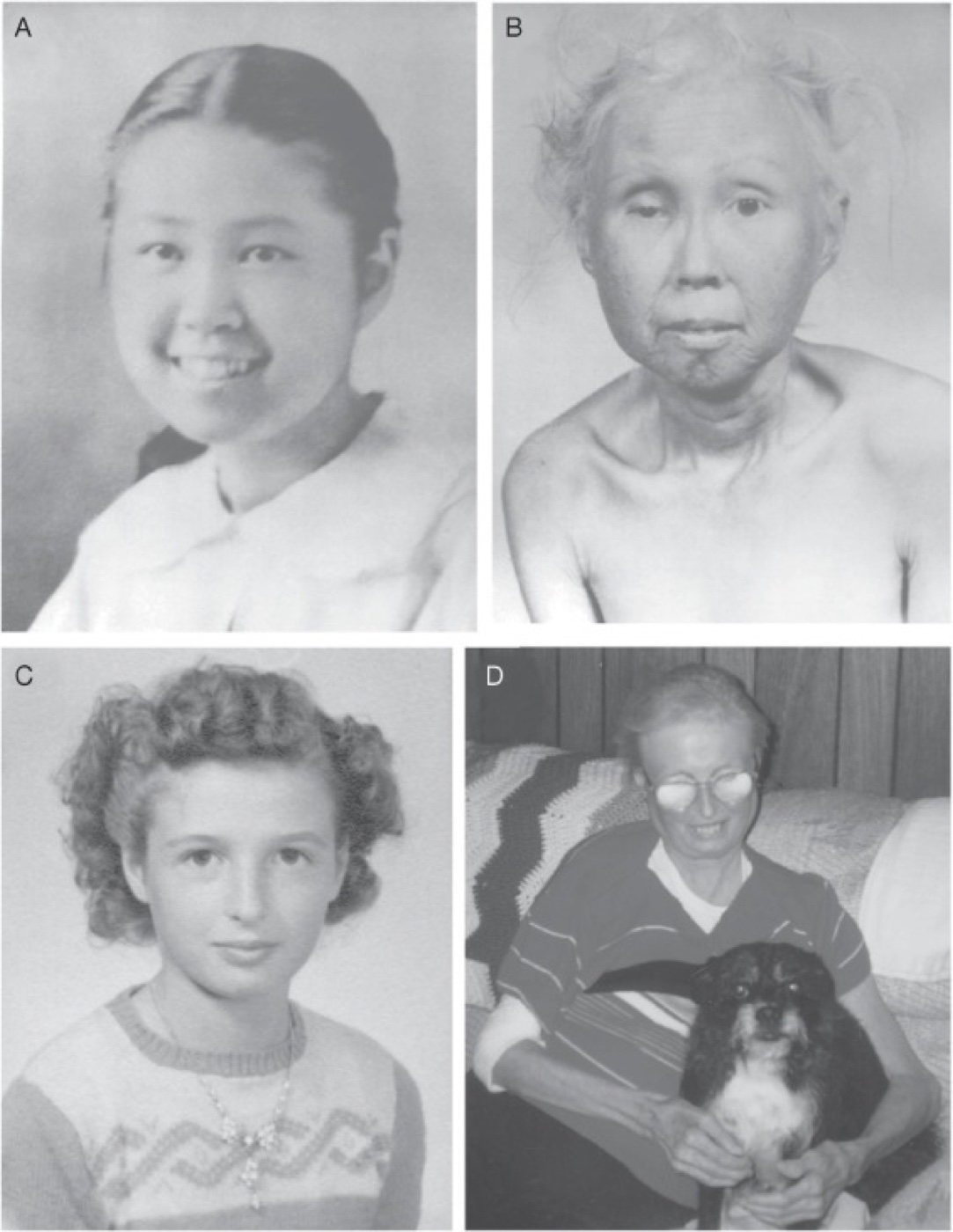
The side by side comparison is people with Werner syndrome. People with Werner age prematurely. Someone in their 30s has the grey hair, brittle bones and failing eyesight as someone in their 70s.
For years, nobody knew why. Then researches traced the entire disease to one broken gene: WRN.
To study further, scientists mutated yeast cells to have Werner syndrome. The expected happened, their life-span decreased by half, just like humans.
What happened next was fascinating. In response to DNA damage, a protein called Sir2 left its job of silencing genes, and moved to repair the damaged DNA. When it finally fixed the damage, it returned to its post…except in a slightly different place.
Sounds familiar?
You’ve met Sir2 before. It’s our page-turners.
Sir2 was the first Sirtuin ever discovered. We found six more since, grouped under the “Sirtuins” category. Sirtuins stands for “silent information regulator”. They are our page-turners, regulating which pages stay open or closed, and responsible for fixing technical difficulties backstage. The yeast experiment showed the loop in inside a living cell: damage, interruption, repair, return, wrong post.
But all that work cost energy. Just like normal humans, each action consumes energy. Humans gain energy via food. Page-turners, or Sirtuins, gain energy from a molecule called nicotinamide adenine dinucleotide. Or NAD.
NAD is the page-turners fuel. With the exception of ATP, NAD is the most abundant molecule in our body. Our bodies naturally produce NAD from foods such as whole grains, beans and nuts.
But as we age, our NAD levels decline. Why? We don’t know.
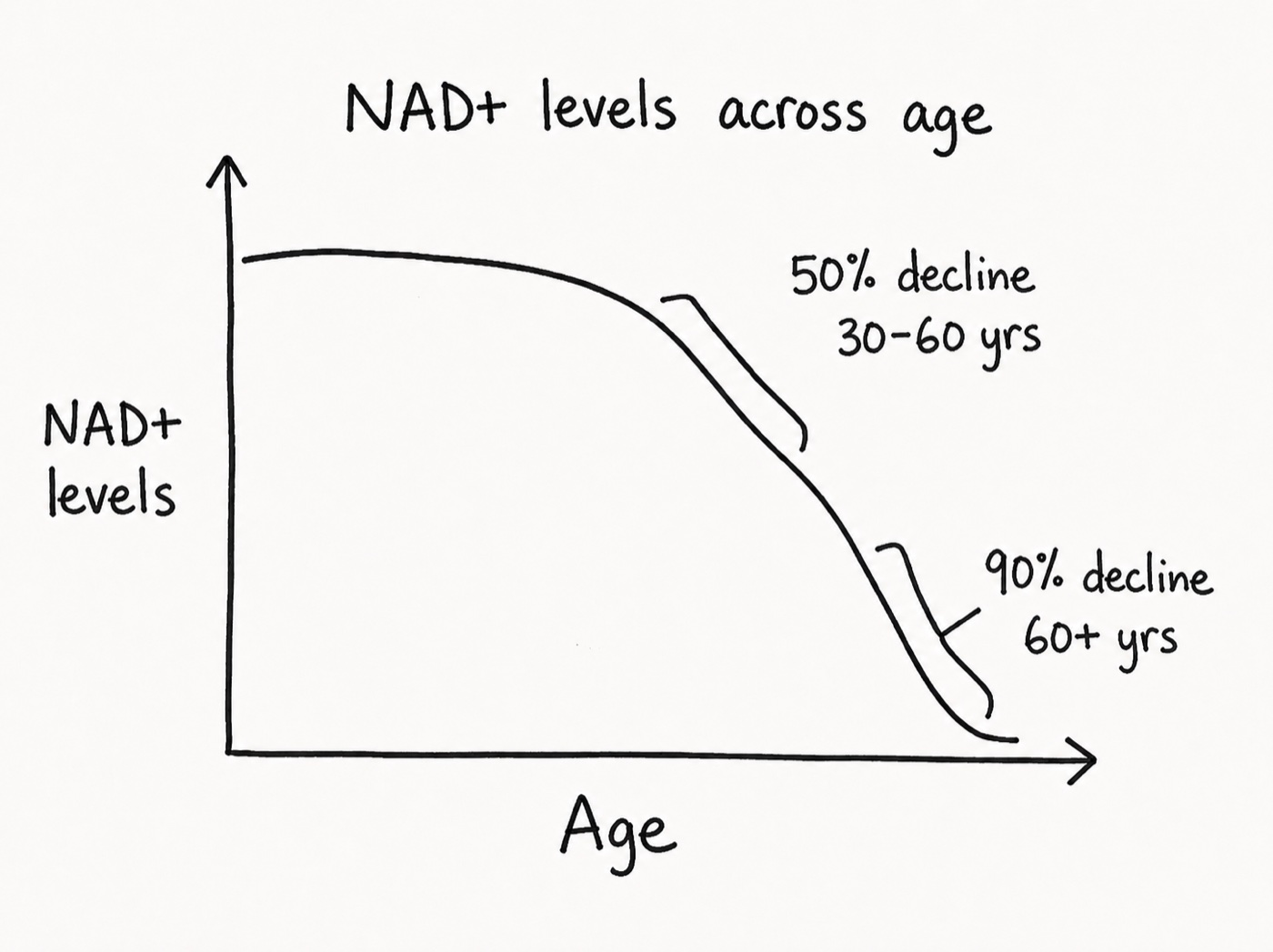
Now you can see the dilemma. A body with accumulated DNA damage means more backstage emergencies. More repair trips. Falling NAD means less fuel. To compensate, page-turners leave some emergencies unattended. And they forget-more on which pages should stay open or closed. The damage loop accumulates, causing accelerated aging.
Can we trick older body to activate Sirtuins by giving it more NAD?
That’s exactly what researchers did by giving mice a molecule called “NMN”. NMN is a precursor which the body converts to NAD.
An NMN-infused old mice ran 50% further than normal mice. The older mice ran so far that it broke the treadmill machine. That would be like taking a 70 year-old and making them run ultra-marathon faster than a 20 year-old. If proven in humans, we could be seeing 90 year-olds winning Olympic medals.
Like NMN, there are other NAD-booster Sirtuin activating compounds.
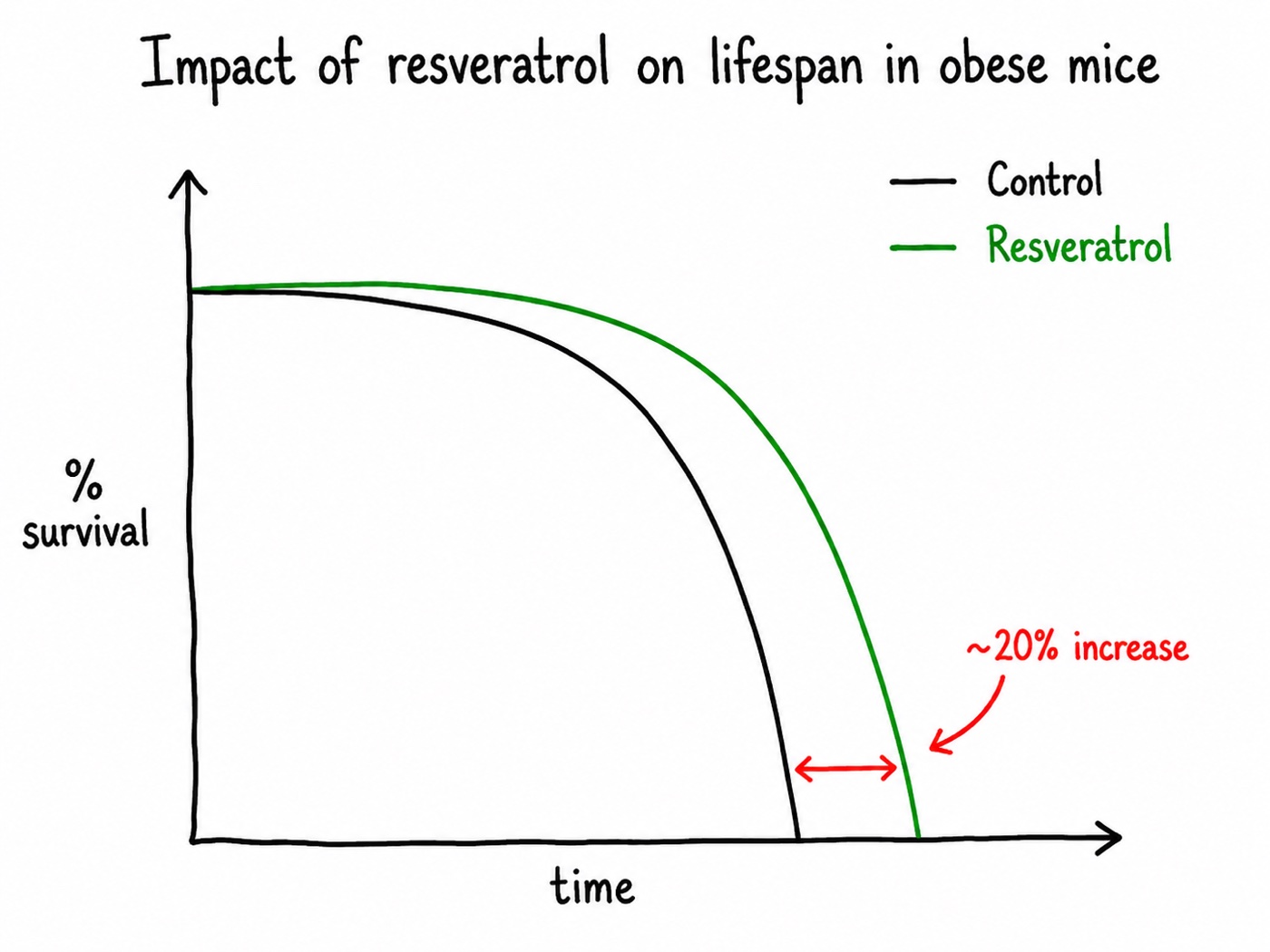
Resveratrol, naturally found in grapes, was shown to extend lifespan in obese mice. Before you rush to buy grapes, to match the doses used in mice, you'd need somewhere between 10,000 to 30,000 grapes each day. Supplementation is the quicker route.
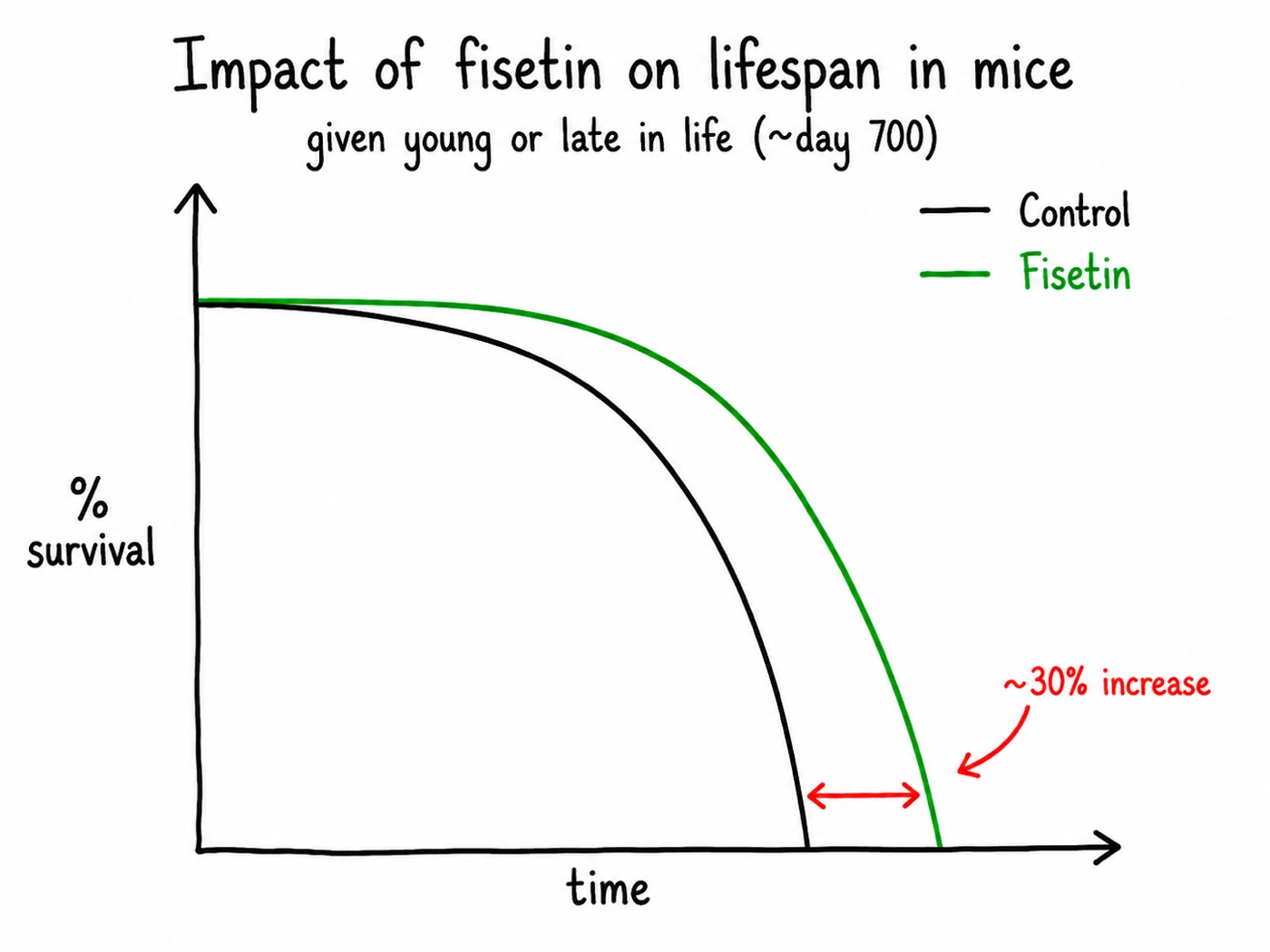
Fisetin, found in higher concentrations in strawberries. Besides activating Sirtuins, it seems to get rid of zombie-like senescent cells that accumulate overtime, causing inflammation. These are emergencies our page-turners ignored due to lack of NAD fuel.
There are other interventions like peptides, exosomes and cellular reprogramming that have shown remarkable promises to stop/reverse aging. That’s a topic for next essay.
Notes
[1] https://www.bmj.com/content/370/bmj.m2412
[2] https://pmc.ncbi.nlm.nih.gov/articles/PMC8978023/
[3] Look up Alex Leonidas. He eats 90g protein per day, down from 300g protein, and still won silver medal at Open Classic Physique division, top most competition for natural bodybuilding.
[4] 1.4g/kg bodyweight if very lean and prepping for a sports competition.
[5] 16:8 == fasting for 16 hours and eating during an 8-hour window. Extended fasting == 1-3 days of fasting every few months.